By CyberDudeBivash Pvt Ltd – Crypto Security, AI & Blockchain Infrastructure Ecosystem
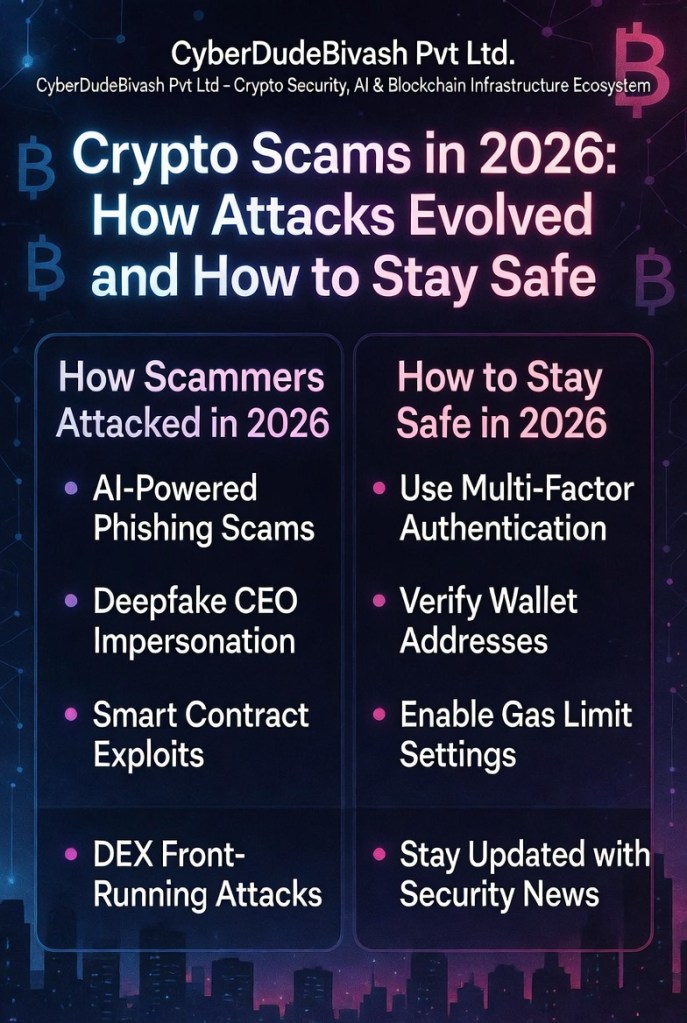
Introduction: Scams Didn’t Disappear — They Upgraded
Every year, people claim crypto scams are “getting worse”.
That’s not accurate.
Crypto scams are getting smarter.
By 2026, attackers are no longer amateurs sending broken emails or fake giveaway tweets. They operate like professional threat actors, using automation, AI, psychology, and deep understanding of blockchain mechanics.
At CyberDudeBivash Pvt Ltd, we track crypto scams the same way cybersecurity teams track malware campaigns — by patterns, infrastructure, and behavior, not headlines.
This guide explains how crypto scams evolved in 2026, why most victims never realize what happened, and how disciplined users protect themselves.
1. The Biggest Lie About Crypto Scams
The most dangerous belief in crypto is:
“Only beginners get scammed.”
This belief is false — and expensive.
In 2026, experienced users lose more money than beginners, because:
- They transact more often
- They trust familiar interfaces
- They underestimate social engineering
- They assume experience equals immunity
Attackers target confidence, not ignorance.
2. The New Crypto Scam Landscape (2026)
Crypto scams today fall into four dominant categories:
- Wallet drain attacks
- Social engineering impersonation
- Infrastructure & tooling compromise
- Psychological manipulation scams
Each exploits a different human weakness — not technical flaws.
3. Wallet Drainers: The Most Profitable Scam Model
What Is a Wallet Drainer?
A wallet drainer is a malicious smart contract designed to:
- Request legitimate-looking approvals
- Gain unlimited token access
- Drain assets silently after signing
The victim:
- Signs once
- Sees no immediate loss
- Loses funds later
This delay is intentional. It avoids suspicion.
CyberDudeBivash data shows wallet drainers are responsible for the majority of retail losses in 2026.
4. Why Wallet Drainers Are So Effective
They exploit:
- Blind signing
- Complex calldata
- Trust in known wallets
- Habitual clicking
Victims often believe:
- “It was a normal transaction”
- “The site looked legit”
- “Everyone else was using it”
The blockchain executed exactly what was approved.
5. Fake Airdrops & “Claim” Traps
Airdrop scams remain effective because they exploit:
- Greed
- Urgency
- Social proof
In 2026, fake airdrops use:
- AI-generated websites
- Copy-pasted real branding
- Fake transaction history
- Influencer impersonation
One approval is enough.
CyberDudeBivash enforces one rule:
Never claim anything from a wallet that holds value.
6. Social Engineering: The Real Weapon
Fake Support & Compliance Scams
Modern scams impersonate:
- Exchange support
- Wallet teams
- Compliance departments
- “Security alerts”
They use:
- Professional language
- AI chatbots
- Deepfake voice messages
- Realistic email domains
No legitimate crypto service:
- DMs you first
- Asks for urgency
- Requests private keys
- Forces immediate action
Pressure equals fraud.
7. AI Changed Crypto Scams Forever
AI enables attackers to:
- Scale scams globally
- Personalize messages
- Mimic real people
- Remove spelling errors (a major red flag)
This is why traditional scam advice no longer works.
CyberDudeBivash focuses on behavioral defense, not pattern spotting.
8. Browser & Extension Compromise Attacks
One of the most overlooked attack vectors in 2026 is the browser environment.
Attackers compromise:
- Browser extensions
- Clipboard managers
- Fake wallet updates
- Malicious RPC endpoints
Once compromised, even legitimate actions become dangerous.
CyberDudeBivash treats browser security as part of crypto security, not a separate concern.
9. Fake Trading Bots & “Guaranteed Profit” Tools
These scams persist because they exploit:
- Laziness
- Overconfidence
- Desire for automation
Common patterns:
- Closed-source bots
- Guaranteed returns
- Fake testimonials
- Referral pressure
If a tool guarantees profit, it is lying.
CyberDudeBivash builds automation for risk reduction, not profit promises.
10. Rug Pulls in 2026: Fewer, But Deadlier
Rugs didn’t disappear — they became slower and smarter.
Modern rug pulls involve:
- Long trust-building phases
- Partial exits
- Governance manipulation
- Liquidity control abuse
They target patient users, not impulsive ones.
11. Builders as Targets: Supply Chain Attacks
Developers and teams are prime targets.
Attackers compromise:
- GitHub repos
- CI/CD pipelines
- Dependency packages
- API keys
One compromised build can infect thousands of users.
CyberDudeBivash advises builders to treat supply chain security as mission-critical.
12. Why Victims Don’t Report Scams
Most victims:
- Feel embarrassed
- Assume nothing can be done
- Don’t understand what happened
This silence helps attackers.
CyberDudeBivash promotes education over shame — because awareness prevents repeat losses.
13. How Professionals Actually Avoid Crypto Scams
Professionals don’t rely on luck.
They:
- Use wallet compartmentalization
- Limit approvals
- Verify contracts manually
- Separate identities
- Assume compromise is possible
Security is proactive, not reactive.
14. Incident Response: What To Do Immediately
If you suspect compromise:
- Stop all transactions
- Move funds to a clean wallet
- Revoke all permissions
- Secure devices & browsers
- Analyze what failed
Speed matters more than blame.
CyberDudeBivash is building incident-response playbooks and tools to reduce damage windows.
15. Builders: Scam Resistance Is Your Responsibility
If users get scammed through your product:
- Trust collapses
- Regulators pay attention
- Reputation suffers
Clear warnings, transparent UX, and permission visibility are security features, not UI clutter.
16. The CyberDudeBivash Scam Defense Framework
We follow six rules:
- Assume deception
- Eliminate urgency
- Separate wallets
- Minimize approvals
- Secure the environment
- Educate continuously
Scams fail when users slow down.
Final Verdict: Scams Thrive on Speed, Confusion, and Ego
Crypto scams in 2026 succeed because:
- People rush
- People assume immunity
- People trust interfaces
They fail when users:
- Pause
- Verify
- Limit exposure
Crypto is adversarial by nature.
Those who respect that reality survive.
Call to Action (Authority-Grade)
If you want to:
- Avoid wallet drain attacks
- Detect scam patterns early
- Build scam-resistant habits
- Protect long-term capital
Explore the CyberDudeBivash ecosystem, where crypto security is treated as threat intelligence, not fear-mongering.
 Cyberdudebivash
Leave a comment