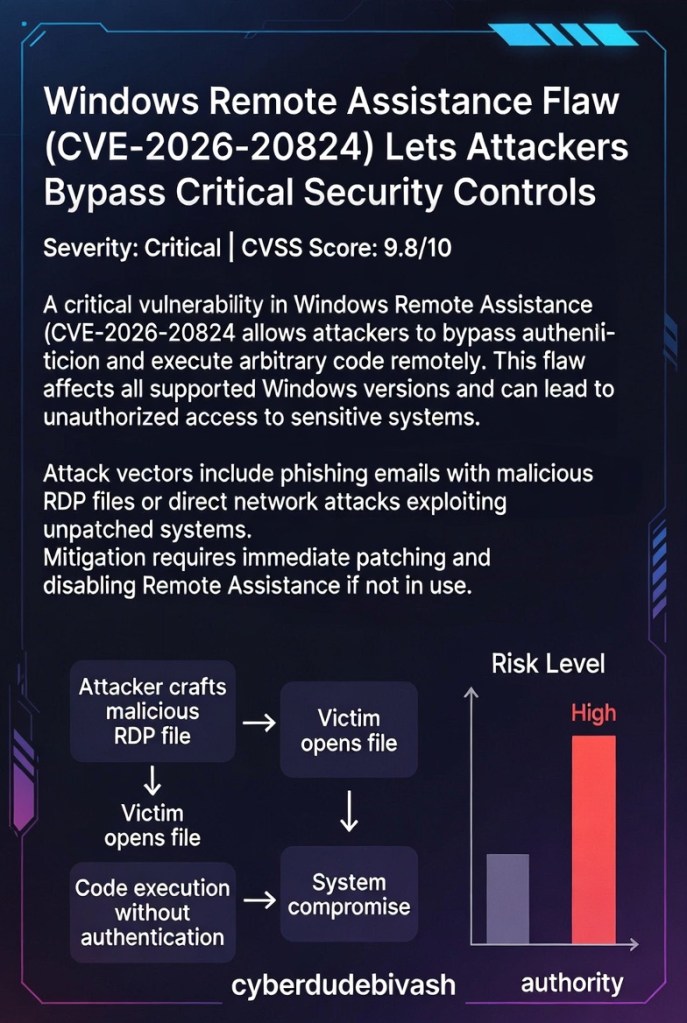
Windows Remote Assistance Flaw (CVE-2026-20824)
Lets Attackers Bypass Critical Security Controls
Authorized by CYBERDUDEBIVASH ECOSYSTEM – Leading AI-Powered Cybersecurity Authority
Published: January 15, 2026
In the dynamic world of cybersecurity threats and AI-enhanced attack vectors, even seemingly minor vulnerabilities can create significant enterprise risks. On January 13, 2026, Microsoft released its Patch Tuesday updates addressing CVE-2026-20824 — a critical security feature bypass in Windows Remote Assistance. This flaw enables attackers to evade the Mark of the Web (MOTW) protections, allowing untrusted content to execute in a trusted context.
At CYBERDUDEBIVASH ECOSYSTEM, our mission is to deliver real-time threat intelligence, advanced cybersecurity services, and innovative AI products that empower organizations worldwide. This comprehensive guide provides crystal-clear technical details, practical mitigations, and how our APPS, SERVICES, PRODUCTS, CORPORATE REALTIME TRAININGS, and FREELANCE SERVICES help you stay protected.
What Exactly is CVE-2026-20824?
CVE-2026-20824 is a protection mechanism failure (CWE-693) affecting Windows Remote Assistance (msra.exe / Quick Assist). The vulnerability occurs when handling specially crafted files or session invitations, failing to apply the Mark of the Web correctly. This bypasses safeguards like SmartScreen, macro blocking, and zone-based restrictions.
Key Details:
– CVSS v3.1 Score: 5.5 (Important)
– Vector: AV:L/AC:L/PR:L/UI:N/S:U/C:N/I:H/A:N
– Attack Vector: Local (low privileges required)
– Exploitability: Less Likely (no known public exploits as of January 2026)
– Affected Platforms: Windows 10 (21H2/22H2), Windows 11 (23H2/24H2/25H2), Windows Server 2012–2025
How the Bypass Actually Works
- Attacker delivers a crafted Remote Assistance invitation file (via phishing, USB, or share).
- User or system processes the file during assistance session initiation.
- Windows fails to tag content with MOTW, treating it as trusted/local.
- Malicious payload (macros, scripts, executables) runs without restrictions.
- Result: Malware execution, credential theft, or ransomware deployment under elevated trust.
This fits the pattern of recent MOTW bypass trends, amplifying risks in helpdesk-heavy environments or shared systems.
Real-World Risks in 2026 Threat Landscape
With AI-powered phishing and living-off-the-land attacks rising, MOTW bypasses lower defenses for chained exploits. Helpdesk teams using Remote Assistance could unwittingly introduce threats, making patching essential.

Recommended Mitigations & Best Practices
- Patch Immediately: Apply January 13, 2026 Windows security updates via WSUS/Intune.
- Disable if Unused: Group Policy → System → Remote Assistance → Configure Offer Remote Assistance = Disabled.
- Restrict Execution: Use AppLocker/WDAC to block msra.exe if needed.
- Monitor & Harden: Enable strict MOTW via registry; log Remote Assistance activity.
Protect Your Organization with CYBERDUDEBIVASH ECOSYSTEM
Don’t rely on patches alone. Leverage our integrated suite:
- CYBERDUDEBIVASH Cybersecurity APPS – Real-time MOTW monitors & vulnerability scanners.
- CORPORATE REALTIME TRAININGS – Expert-led sessions on Windows hardening & threat hunting.
- FREELANCE SERVICES – Custom pentests, compliance audits, and Remote Assistance lockdown implementations.
- APPS DEVELOPMENT & SHIPPING SERVICES – Bespoke AI-driven endpoint protection tools.
- Threat Intelligence PRODUCTS – Daily CVE alerts & exploit scoring.
Explore CYBERDUDEBIVASH ECOSYSTEM Now →
Join our Affiliates Program and promote world-class cybersecurity solutions while earning rewards: Become an Affiliate Today.
Ready for Enterprise-Grade Protection?
Schedule FREE Cybersecurity Consultation
Stay secure. Stay proactive. The CYBERDUDEBIVASH ECOSYSTEM – Pioneering the Future of AI-Powered Cybersecurity.
#Cybersecurity #CVE202620824 #WindowsSecurity #PatchTuesday #AICyberDefense
© 2026 CYBERDUDEBIVASH ECOSYSTEM – All Rights Reserved | Authorized Premium Blogger Content
http://www.cyberdudebivash.com | Empowering Secure Digital Futures
 Cyberdudebivash
Leave a comment